Kāinga Ora development at 32 Delhi Avenue
Resource consent has been granted for Kāinga Ora to develop a vacant lot at 32 Delhi Avenue in Aramoho.
The site is close to parks, early childhood education and Churton School. It’s 3.8km from the Aramoho Neighbourhood Centre, which has shops and health and community services, and it’s 350m from a bus stop to connect across Whanganui.
The surrounding area has a diverse range of architectural styles with a mix of single and two-storey homes.
There was an existing consent for 32 Delhi Avenue for development at a similar overall density.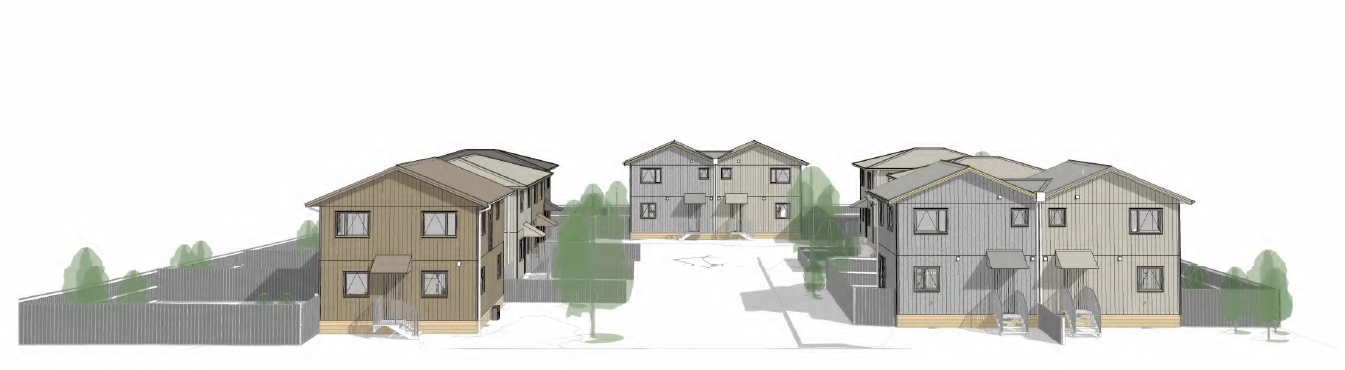
The council’s role
Kāinga Ora is the landowner and developer. It decides where to buy land to propose new housing. The council meets with Kāinga Ora to support information-sharing between agencies on housing need but does not choose sites or have input on individual developments.
The council’s role is to assess applications under the Resource Management Act 1991 and the District Plan. This process considers whether the proposal meets planning rules, looking at effects on neighbouring properties and the wider area.
Correspondence with residents
While a resource consent application is being assessed, legislation limits what the council can comment on for that development.
In correspondence with residents, we were able to make a comparison between 32 Delhi Avenue and an existing development near the corner of Lucknow Street and Delhi Avenue.
This was to highlight that the Lucknow/Delhi development has a considerably higher density than 32 Delhi Avenue, with single storey houses covering around 38 percent of the site compared to 32 Delhi Avenue where a mix of two storey standalone houses and duplexes are planned to cover 18 percent of the site.
Whether an application is publicly notified is determined by the Resource Management Act. The decision is based on the likely effects of the proposal.
Why consent was granted
An independent planner assessed the application and considered likely effects on surrounding properties.
Some people will be aware that the district plan allows for residential development up to two stories in height at a density of one dwelling per 400m². What might be less well known is that the district plan allows for a higher density of development with the right kind of urban design in place.
The assessment found the proposal for 32 Delhi Avenue met the required standards and the design was responsive to its context in this suburban-to-rural-edge location.
Findings in the report included:
- the buildings have significant separation from neighbouring properties, with setbacks ranging from 15 to 40 metres to help protect privacy and reduce overlooking
- there are generous, landscaped, private and shared outdoor spaces with buildings covering just 18 percent of the site
- storage, rubbish and clothesline areas are screened
- on-site parking is provided, with one space for two-bedroom homes and two spaces for larger homes
- the frontage includes clear accessways, with low fencing and landscaping to support safety and a positive street presence
- the homes are designed to capture sunlight where possible and provide practical indoor-outdoor living.
Minor opportunities for refinement were identified, such as orientation and placement of one of the units, and aspects of architectural detailing. These matters do not change the overall assessment and can be addressed within the approved consent.
Minimum finished floor levels will address localised ponding identified on the site.